Homemade Sourdough Bread Recipe
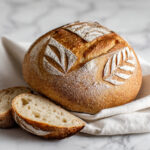
This classic sourdough bread recipe guides you through creating bakery-quality sourdough loaves at home using a natural starter and simple ingredients. The process involves making a pre-ferment, multiple folds to develop gluten, proofing, and baking in a Dutch oven to achieve a crusty, flavorful loaf with a chewy interior.
- Prep Time: 15 minutes (plus 12 hours pre-ferment and 3 hours bulk fermentation)
- Cook Time: 50 to 55 minutes
- Total Time: Approximately 16 to 17 hours including resting and proofing times
- Yield: 1 loaf (about 900g to 1000g bread)
- Category: Bread
- Method: Baking
- Cuisine: American / Artisan
- Diet: Vegetarian
Ingredients
Pre-ferment
- 15g Active Sourdough Starter
- 120g lukewarm water
- 105g whole wheat or all-purpose flour
Main Dough
- 240g lukewarm water
- 375g all-purpose or bread flour, plus extra for kneading
- 12g fine sea salt
Instructions
- Make the pre-ferment: In a large glass bowl, mix the active sourdough starter with 120g lukewarm water. Stir in 105g whole wheat or all-purpose flour until a shaggy dough forms, about 1 to 2 minutes. Cover with plastic wrap and let sit at room temperature for approximately 12 hours to ferment and develop flavor.
- Mix the main dough: After the pre-ferment has rested, add 240g lukewarm water to the bowl and combine with your hands until fully mixed. Add the 375g all-purpose or bread flour and mix by hand until a shaggy dough forms. Cover with plastic wrap and let it rest for 1 hour (autolyse) to hydrate the flour fully.
- Add the salt and fold: Uncover the dough and sprinkle the 12g fine sea salt evenly over the surface. With wet hands, pinch and fold the dough repeatedly until the salt is fully incorporated.
- Perform stretch and folds: Using wet hands, pull the dough from underneath and fold it over the top, pressing down gently to avoid overstretching. Rotate the bowl and repeat this motion 15 to 20 times. Cover with plastic wrap and rest for 30 minutes. Repeat this stretch and fold process every 30 minutes for a total of 6 times over 3 hours. The dough will begin to rise and strengthen during this period.
- Bulk fermentation rest: After the last fold, cover the dough and let it rest another 30 to 45 minutes to allow further fermentation.
- Shape the dough: Gently turn the dough out onto a lightly floured surface to preserve air bubbles. If making multiple loaves, divide the dough evenly by weight. Shape the dough by pulling the corners into the center to form a loose circle. Using a bench scraper, flip the dough over so the seam is down and let it rest for 30 minutes.
- Prepare the proofing basket: Generously dust a proofing basket with rice flour or all-purpose flour. If unavailable, use a floured tea towel placed inside a colander or medium bowl to create a similar environment.
- Final shaping: Dust the top of the loaf with flour and flip it over. Gently stretch and fold the dough sides toward the center multiple times, then cup and rotate the dough on the counter to create a tight, round loaf. Place the shaped dough seam-side up into the floured proofing basket. Sprinkle additional flour on top and cover with a tea towel.
- Proof the dough: Let the dough rise at room temperature for 2 to 3 hours. Alternatively, for longer proofing, allow it to rise at room temperature for 30 to 40 minutes, then refrigerate for 12 to 24 hours.
- Preheat the oven: Heat the oven to 475°F (245°C) with a rack in the center. Prepare a 5-quart Dutch oven by preheating it inside the oven if desired.
- Bake the bread: Place parchment paper on a flat surface. Carefully invert the dough from the proofing basket onto the parchment, seam side down. Using a lame, sharp knife, or razor, score a vent on top of the dough. Transfer the dough along with the parchment paper into the Dutch oven. Cover and bake for 25 minutes. Remove the lid and bake an additional 25 to 30 minutes uncovered until the crust is deeply browned and crusty.
- Cool: Remove the bread from the oven and let it cool completely on a wire rack for at least 30 minutes before slicing to allow the crumb to set properly.
Notes
- To make multiple loaves, multiply each ingredient by the number of loaves desired. For example, for 2 loaves use: 30g active sourdough starter, 240g lukewarm water (pre-ferment), 480g lukewarm water (main dough), 210g whole wheat or all-purpose flour, 750g all-purpose or bread flour, 24g fine sea salt.
- Room temperature proofing times can vary depending on ambient temperature; cooler environments require longer proofing.
- Using a Dutch oven creates steam which is essential for a crispy crust. If unavailable, use a baking stone and add steam to the oven manually.
- Retarding the dough in the refrigerator enhances sour flavor complexity and makes handling easier.
- Always use wet hands for folding to prevent dough from sticking.
Find it online: https://marthatasty.com/homemade-sourdough-bread-recipe/